Furnace Repair Colorado Springs: No Heat? Start Here
No heat on a January night is not a small problem here. Furnace repair Colorado Springs calls spike when lows drop toward the 7 degree design temperature, and an unheated house puts water pipes at risk the same night. This page lists real local prices, simple checks to try first, and what a fair written quote should show before any work begins.
- Written itemized quotes
- Prices published online
- Altitude-checked repairs
- Local Colorado Springs team
No heat is urgent here
Colorado Springs sits at about 6,035 feet, and winter nights fall fast. January lows average 18.5 degrees, and the heating design temperature is about 7 degrees. In that cold, a dead furnace is not just uncomfortable. Pipes on outside walls can start to freeze within hours, and a burst pipe costs far more than a heating call.
If children, older adults, or anyone with health needs is in the house, treat no heat as an emergency and call now. Our hours are Mon to Sat 7am to 10pm and Sun 8am to 10pm.
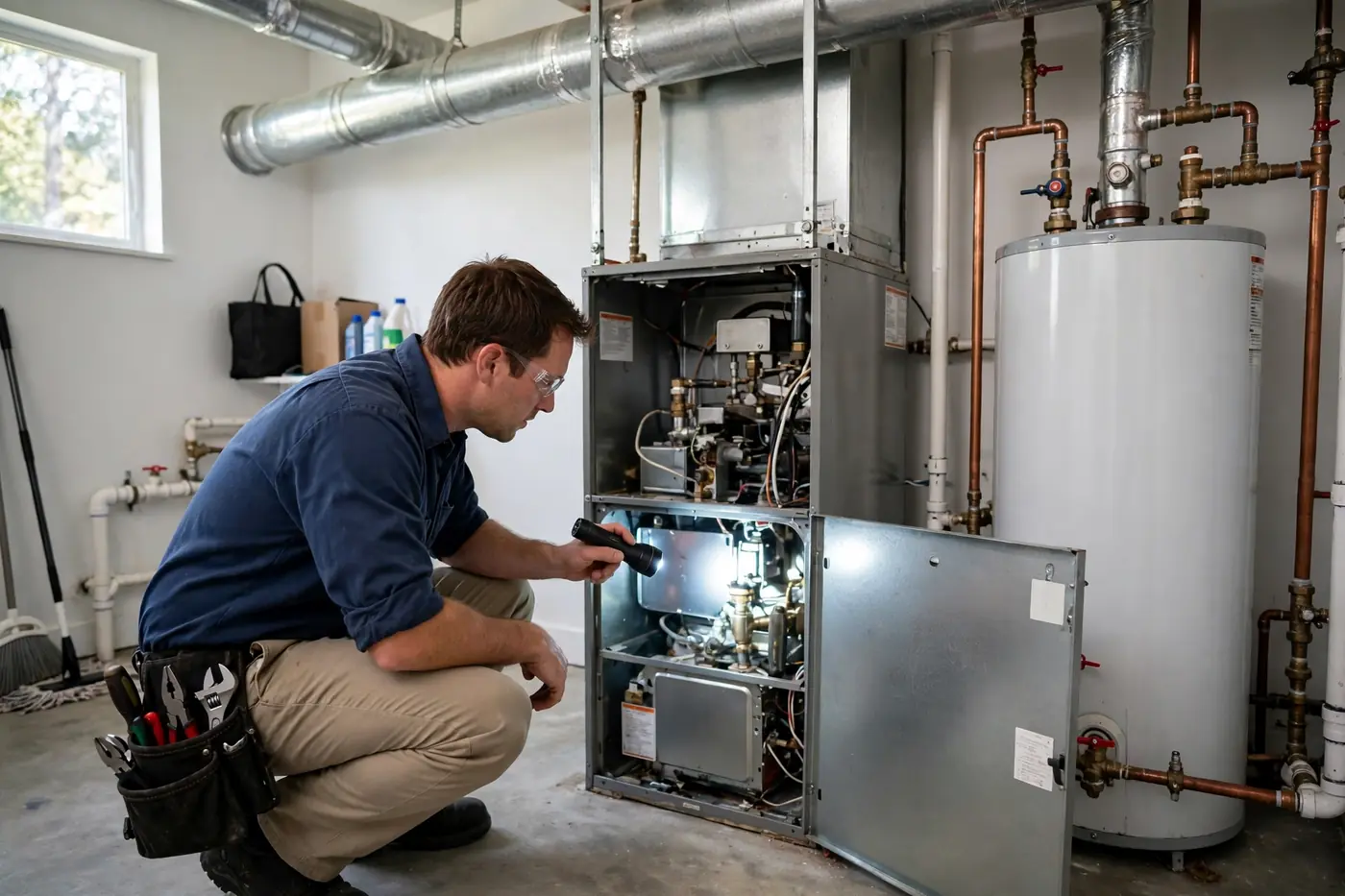
What does furnace repair cost in Colorado Springs?
Most common furnace fixes here cost $100 to $900 for parts and labor, plus an $89 diagnostic visit. Simple parts such as a flame sensor sit at the low end, while blower motors and control boards sit at the high end. Your final price is confirmed in writing before work starts.
Price is the first question on every no heat call, and it should be easy to answer. When you book furnace repair in Colorado Springs, you should be able to see the likely range before a truck rolls, not after a technician is standing in your hallway. The table below shows the typical local ranges we work to in 2026. Your home may land below or above a range if access is tight, if a part is hard to source, or if more than one fault is found, but any change is explained and confirmed in a written quote before the repair goes ahead.
The diagnostic visit is $89. That visit pays for a trained technician, a stocked truck, and proper testing with meters and combustion checks instead of guesswork. It is the local anchor price you will see across the city, and it is confirmed when you book. If a quote you get elsewhere feels high, compare it line by line with this table. One homeowner story that comes up again and again in heating forums is a $2,000 labor quote to change a control board and flame sensor under warranty, when working technicians priced the same job at $350 to $600. Published ranges are how you spot that gap before you agree to anything.
| Repair | Typical cost | What it covers |
|---|---|---|
| Diagnostic visit (typical local fee) | $89 | Full fault finding, safety checks, and a written quote for the repair. |
| Flame sensor clean or replace | $100 to $300 | Cleaning the sensor rod, or fitting a new sensor and testing the start sequence. |
| Hot surface igniter | $150 to $350 | New igniter fitted and tested through several full start cycles. |
| Inducer motor | $400 to $800 | Draft inducer motor and wheel, with venting and pressure switch checks. |
| Blower motor | $400 to $900 | Blower motor replacement, capacitor where fitted, and airflow checks. |
| Control board | $400 to $800 | New control board, wiring checks, and full system test on heat. |
| Gas valve | $300 to $600 | Gas valve replacement with leak testing and manifold pressure set for altitude. |
Typical Colorado Springs ranges for parts and labor in 2026. Your final price is always confirmed in a written quote before work starts.
How a visit works
Call and describe the fault
Tell us what the furnace does, word for word if you can. Lights then stops, blows cold air, or will not start at all each point to a different short list of parts, and it helps the technician load the right spares.
Diagnostic visit for $89
The technician tests the start sequence, checks gas pressure and combustion, and confirms the altitude settings. You get the fault in plain words, plus the repair price in writing, before you decide.
Repair at the quoted price
If you go ahead, the repair is done at the price on the quote. You see the invoice before you pay, and the old part is yours to keep or inspect. If the numbers point to replacement instead, we say so and show the maths.
If your furnace is older and the repair quote is climbing, use the simple $5,000 rule local homeowners repeat: multiply the age of the system by the repair cost, and if the result is over $5,000, replacement usually deserves a hard look. Our furnace replacement cost guide walks through that decision with local replacement prices, so you can compare both paths side by side. Some households use the same moment to weigh a heat pump instead of another gas furnace; how those systems hold up here is covered under heat pump repair.
Emergency furnace repair Colorado Springs: what to do when the heat stops
Emergency furnace repair Colorado Springs homeowners need is usually needed at the worst hour: late at night, during a cold snap, with the house cooling by the hour. Not every fault is an emergency, but some situations should never wait until morning. Use this section to judge yours, and call while you work through the checks.
What counts as an emergency
No heat with young children, older adults, or anyone unwell in the house counts as an emergency in this climate, because indoor temperatures can fall below freezing in an unheated house on a design temperature night. A furnace that trips a carbon monoxide alarm is an emergency. A strong gas smell is an emergency of a different kind, and it is handled by leaving first, not by calling a repair company from the kitchen. Loud banging, a burning smell, or visible damage to the vent pipe also means switch the system off and call.
Smell gas? Leave first. Get everyone out of the house, do not touch light switches or appliances, and call 911 or Colorado Springs Utilities from outside or from a neighbor. If a carbon monoxide alarm sounds, get out into fresh air and call 911. A repair visit comes after the home is cleared as safe.
Why pipes set the clock
The real deadline on a cold night is your plumbing. Pipes begin to freeze at about 20 degrees Fahrenheit or below, and water in pipes in an unheated area can start to freeze after roughly six hours once it is below freezing. Exposed pipes on outside walls, in garages, and in crawl spaces are at risk first, and in as little as two to three hours in the coldest spots. That is why a furnace that dies at 9pm in January cannot always wait for a routine slot the next afternoon.
While you wait for help, let faucets drip slowly, open the cabinet doors under sinks on outside walls, close off unused rooms, and keep everyone in one warm room if the house is cooling. A space heater can help in that one room, kept clear of bedding and curtains and never left running while you sleep. If you are away from home for a PCS move or a trip, keep the thermostat at 55 degrees or higher, which is the setting widely cited to protect pipes, and ask a neighbor to check the house during cold snaps.
Our hours are Mon to Sat 7am to 10pm and Sun 8am to 10pm. If your call falls inside those hours and the house has no heat, say so clearly when you call and we will treat it as the priority it is. Call +1 (719) 555-0100 and describe what the furnace is doing, when it stopped, and whether anyone vulnerable is at home. That detail shapes how the visit is planned.
Common furnace faults we fix in Colorado Springs homes
Most no heat calls in this city come down to a short list of parts. The heating season runs from late September to late April, and furnaces that sat idle all summer often fail on the first cold nights of October. Here are the six faults behind most of our winter call outs, in the words homeowners use to describe them.
Hot surface igniter failure
The igniter glows to light the burners, and it is one of the hardest working parts in the furnace. When it cracks or wears out, the furnace tries to start, nothing lights, and the system shuts down and retries. Homeowners describe it as the furnace clicking and humming but never firing. Replacement is a common, mid priced fix.
Dirty flame sensor
This is the fault behind the classic call: the furnace ignites, then goes out after about 10 seconds. A thin coating builds up on the sensor rod, the board cannot prove flame, and it shuts the gas off for safety. A careful clean often restores it, and a new sensor is one of the lowest cost repairs on the table above.
Blower motor failure
The blower pushes warm air through the ducts. When the motor or its capacitor fails, you may hear the burners light but feel little or no air at the vents, or hear a humming or grinding from the cabinet. The furnace then shuts down on its high limit switch to protect itself from overheating.
Control board faults
The board runs the whole start sequence, from inducer to igniter to gas valve to blower. A failed board can cause random shutdowns, a blower that never stops, or a furnace that does nothing at all. Board faults need proper testing, because several cheaper parts can mimic a dead board and should be ruled out first.
Inducer motor problems
The inducer starts every heating cycle by clearing the heat exchanger and proving the vent is open. A worn inducer gets loud, rattles, or fails to start, and the furnace will not light at all. At altitude the pressure switch that watches the inducer is set for thin air, so the replacement has to match the altitude kit.
Thermostat and airflow issues
Not every no heat call is a broken furnace. Dead thermostat batteries, a thermostat set to cool or to fan on, a clogged filter, closed vents, or a blocked return can all stop a healthy furnace heating the house. These are the checks worth doing before you book, because they cost nothing and fix a surprising share of calls.
Why is my furnace blowing cold air or short cycling?
Start with the basics before you assume a major fault. Check the filter, thermostat batteries, breaker, furnace switch, and outside vent for snow. Many no heat calls trace back to one of those five items. If the furnace still blows cold air or starts and stops, book a diagnostic visit.
Blowing cold air
If the vents blow room temperature air, first check the thermostat. If the fan is set to on, it runs all the time, including between heating cycles, and the air feels cold even though the furnace is fine. Set the fan to auto and the heat to a few degrees above room temperature, then listen for the start sequence. If the burners light and then stop within seconds, the flame sensor is the usual suspect. If nothing lights at all, the igniter leads the list. A filter clogged solid can also trip the high limit switch and leave the blower pushing unheated air while the burners stay off.
Short cycling
Short cycling means the furnace starts, runs for a few minutes, stops, and starts again soon after. It wears parts out, heats the house badly, and pushes bills up. Common causes are a dirty filter choking airflow, a dirty flame sensor cutting the burners early, an oversized furnace, or altitude settings that were never corrected when the system was fitted. At 6,000 feet, a furnace set up for sea level can overheat and trip its limits again and again, which looks exactly like short cycling. Airflow has a second suspect worth ruling out while you are at it: ducts loaded with renovation dust or debris can starve a furnace the same way, which is the narrow case where duct cleaning actually earns its money.
It will not start when temperatures dip
Some furnaces work fine on mild days and fail only in a cold snap. Longer run times and more starts expose weak parts: a tired igniter, a marginal pressure switch, a sensor that is nearly too dirty to prove flame, or a condensate line that freezes in an unheated space. Snow blown against the outside vent can block it overnight and stop the furnace starting at all. When you call, say that the fault only happens in deep cold. That one detail changes what gets tested first.
The furnace stops at night
Waking up to a cold house is the most common winter call we hear about. Night setbacks ask for a long recovery run in the coldest hours, which is when marginal parts give up. Snow covering the vent during the night, a filter passing its limit, or a thermostat battery dying at 2am are all regular findings. Work through the checklist below, and if the furnace restarts but the fault returns the next night, book the diagnostic rather than resetting it again.
- Filter: hold it up to a light. If you cannot see light through it, change it. A clogged filter causes cold air, short cycling, and limit trips.
- Thermostat batteries: a dim or blank screen, or a thermostat that resets itself, often just needs fresh batteries.
- Breaker and switch: check the breaker panel and the furnace switch by the unit, which looks like a light switch and gets knocked off by accident.
- Vent blockage by snow: check the plastic vent pipes outside. Clear snow and ice away gently by hand, and keep the area clear after storms.
- Vents and returns: open supply vents and keep returns clear of furniture, so the furnace can move the air it heats.
Does altitude change how a furnace runs at 6,000 feet?
Gas input must drop by 4 percent for each 1,000 feet above 2,000 feet, so a furnace here needs a 16 to 24 percent reduction. Without that adjustment, combustion suffers, carbon monoxide can rise, and parts wear faster. Ask for the altitude kit and pressure settings on your quote.
Colorado Springs is not a sea level city with colder weather. The air here holds about 20 percent less mass than air at sea level, so a fan moves less air per hour and burners get less oxygen per cubic foot of gas. The National Fuel Gas Code handles this with a simple rule: derate gas appliance input by 4 percent for every 1,000 feet above 2,000 feet. At our elevation that works out to a 16 to 24 percent reduction in gas input, done with high altitude orifices, pressure settings, and pressure switches matched to thin air.
Skip that adjustment and the furnace burns rich. The results are incomplete combustion, sooting, nuisance lockouts, overheating, stressed heat exchangers, and higher carbon monoxide in the flue gases. Local technicians also link unadjusted furnaces to shorter working lives, because the system runs hotter and cycles harder than it was built to. None of this shows on a nameplate or a home listing. You only find it by testing combustion and checking the altitude setup, which is why it belongs in every diagnostic visit here.
This matters most in flipped homes and military rentals. A furnace fitted quickly during a flip, or replaced by a chain working from a sea level checklist, may never have been adjusted for this city. Rentals near Fort Carson and Peterson Space Force Base change tenants often, and no tenant asks about orifice sizes. So ask the question directly: was your furnace adjusted for 6,000 feet? If nobody can answer, get it checked. Good Colorado Springs furnace repair should feel calm and documented, and the altitude settings are part of that paperwork.
How you know the price is fair before work starts
Heating repairs are bought under stress, in a cold house, often at night. That is exactly when clear paperwork matters most. Our promise is simple and it shapes every visit. You get the fault explained in plain words, the price in a written itemized quote before work starts, and the invoice in your hand before you pay. Nothing about the price should be a surprise at the end of the job.
- Itemized written quote before work: parts, labor, and the diagnostic visit shown as separate lines, agreed before the repair starts.
- See the invoice before you pay: you read the full invoice first. Payment comes after you have seen what you are paying for, never before.
- No tip screens: the price on the quote is the price. There is no tablet turned toward you asking for a tip on top of a repair bill.
- Second opinions welcome: on any large diagnosis, take the written quote and get another view. A fair price survives comparison.
The diagnosis that deserves the most care is a cracked heat exchanger. It can be a real safety fault that means the furnace should not run, and it is also the claim behind some of the worst scare selling in this trade. Homeowner forums carry the same story in both directions: an inspector calling a furnace old but working, then a technician finding cracks and quoting a full replacement. Protect yourself with two requests. Ask for camera proof of the crack in your own furnace, and ask for the carbon monoxide reading in writing. A straight company will show you both without an argument.
The same care applies to smaller quotes. If a price moves when you push back, if a fee that was called waived appears on the bill anyway, or if a tune up visit turns into a five figure replacement pitch with a today only discount, slow down and get the second opinion. You can see exactly what a real visit covers on our AC maintenance page, where the tune-up checklist and the written report are published. You can read more about how we work, or send the quote through via our contact page and ask for a plain view on it before you commit.
Heating help across Colorado Springs and nearby communities
We cover the city from the foothills to the plains, including the neighborhoods below. Older homes in Old Colorado City and the Old North End often run older furnaces with little original ductwork. The 1960s to 1990s suburbs across the south and east hold systems that have already been replaced once and are ageing out again. Newer builds along the Powers corridor and in Falcon and Monument run builder grade systems now reaching the age where igniters, sensors, and boards start to fail.
- Briargate
- Powers corridor
- Old Colorado City
- Security-Widefield
- Fountain
- Falcon
- Monument
- Black Forest
- Rockrimmon
- Mountain Shadows
- Broadmoor
- Cimarron Hills
Military families are a large part of this city, and heating work follows their calendar. Five installations ring Colorado Springs, including Fort Carson, Peterson Space Force Base, Schriever Space Force Base, Cheyenne Mountain, and the US Air Force Academy. PCS moves cycle thousands of households in and out each year. New arrivals often search for furnace repair Colorado Springs CO on their first cold night in a house they have owned for a week, and landlords in Security-Widefield, Fountain, and the southeast need fast, documented repairs that tenants and property managers can file. Landlords also ask us about heating repair Colorado Springs tenants can book without fuss during a move out. If you are leaving on a PCS move in winter, set the thermostat to 55 degrees or higher, and book a check before you hand over the keys.
- 80902
- 80903
- 80904
- 80905
- 80906
- 80907
- 80908
- 80909
- 80910
- 80911
- 80912
- 80913
- 80914
- 80915
- 80916
- 80917
- 80918
- 80919
- 80920
- 80921
- 80922
- 80923
- 80924
- 80925
- 80926
- 80927
- 80928
- 80929
- 80930
- 80938
- 80939
- 80951
- 80817
- 80829
- 80831
- 80132
Furnace Repair Questions
These are the questions Colorado Springs homeowners ask us most in winter, answered plainly. If your situation is not covered here, call +1 (719) 555-0100 and describe what your furnace is doing. The exact words help: lights then stops, blows cold, or dead silent each lead somewhere different. When the calendar turns and the same system will not cool, the other half of the team is over on our page for AC repair Colorado Springs homes rely on in summer, and questions that cover both systems at once live on our HVAC repair page. If the verdict here is replacement rather than repair, the furnace installation page walks through install day, permits, and the checks a finished job should pass.
How long can a house go without heat before pipes freeze?
Pipes on outside walls can start to freeze after about six hours in an unheated house once indoor temperatures fall below freezing. Exposed or poorly insulated pipes are at risk around 20 degrees Fahrenheit, and the risk rises fast on windy nights. Let faucets drip, open cabinet doors under sinks, and call for help quickly if the house keeps cooling.
My gas furnace will ignite, then 10 seconds later it goes out. What could this be?
This pattern often points to a dirty or failing flame sensor. The furnace lights, the sensor fails to prove flame, and the control board shuts the gas off for safety. A clean can fix it, and replacement is also common and low cost. An igniter, gas valve, or board fault can look similar, so testing matters before parts are replaced.
Why is my furnace blowing cold air?
Cold air often means the fan is running but the burners are not staying lit. Common causes include a dirty filter, a failed igniter, a dirty flame sensor, a thermostat set to fan on, or a safety lockout after failed starts. Check the filter and thermostat first. If burners light then stop, stop resetting the system and book a diagnostic visit.
What should I do if my furnace stops working at night?
Check the thermostat setting and batteries, look for a blocked or dirty filter, and confirm the breaker and furnace switch are on. Check that snow has not blocked the outside vent. If you smell gas, leave the house and call 911 or the utility from outside. For no heat with children or older adults at home, call for emergency help that night.
How much does furnace repair cost in Colorado Springs?
Most common repairs fall between $100 and $900 for parts and labor, plus an $89 diagnostic visit to find the fault. A flame sensor clean or replacement is often $100 to $300, while motors and control boards cost more. You should get a written itemized quote that confirms the final price before any work starts, so there are no surprises.
Does altitude affect my furnace in Colorado Springs?
Yes. At about 6,000 feet the air holds roughly 20 percent less mass, and gas furnaces must be derated by 4 percent for each 1,000 feet above 2,000 feet. That means a 16 to 24 percent input reduction here. A furnace that was never adjusted can soot, short cycle, lock out, or produce excess carbon monoxide, so ask if yours was set for altitude.
Why does my furnace fail to light at altitude?
Before the burners light, the inducer fan has to prove the vent is clear, and a pressure switch confirms it. That switch reads air pressure, and at 6,000 feet the air is thinner, so a furnace still set for sea level, or one whose altitude kit skipped the pressure switch, can refuse to light or lock out even though nothing is truly broken. The fix is the altitude adjustment itself: derating by 4 percent for each 1,000 feet above 2,000 feet, done with high altitude orifices and pressure settings matched to the elevation. If your furnace clicks, tries to start, and gives up, ask whether its pressure switch and derating were ever set for altitude.
Why does my furnace only fail when temperatures dip?
Cold snaps make a furnace run longer and start more often, which exposes weak parts that cope on mild days. A tired igniter, a marginal pressure switch, a dirty sensor, or a vent partly blocked by snow may only fail under that extra load. Altitude settings matter more in deep cold too. Note when the fault happens and share that detail when you call.
Is an older furnace unsafe by its very nature?
No. Age alone does not make a furnace unsafe. Safety depends on the heat exchanger, venting, gas connections, and combustion results. An older unit does need closer checks, because cracks and carbon monoxide risks rise as parts age. Ask for a combustion reading and, if a crack is claimed, camera proof and the carbon monoxide reading in writing before you decide.
No heat tonight? Call before pipes are at risk
Published prices, an $89 diagnostic visit, and a written itemized quote before any work starts. Hours are Mon to Sat 7am to 10pm and Sun 8am to 10pm.
Call +1 (719) 555-0100